



1976 Daytona 500: Petty Vs. Pearson
by Tom Jensen February 10, 2026
Fifty years ago, two of NASCAR’s greatest ever took the Daytona 500 battle to the last corner of the last lap. And only one would prevail.
Curator’s note: To learn more about Wood Brothers Racing, NASCAR’s longest continually operating team, check out “Wood Brothers Racing 75 Years,” now on display in the NASCAR Hall of Fame’s Great Hall. Click here for more information about the exhibit.
Heavyweight battles create legends and unforgettable moments.
Boxing had Ali vs. Frazer.
The NBA had Magic vs. Bird.
The NFL had Brady vs. Manning.
And NASCAR had Petty vs. Pearson.
And of their many memorable battles, the greatest of all took place at Daytona International Speedway, where a crowd of 125,000 race fans would spend an afternoon they would never forget.
The event was the 1976 Daytona 500.
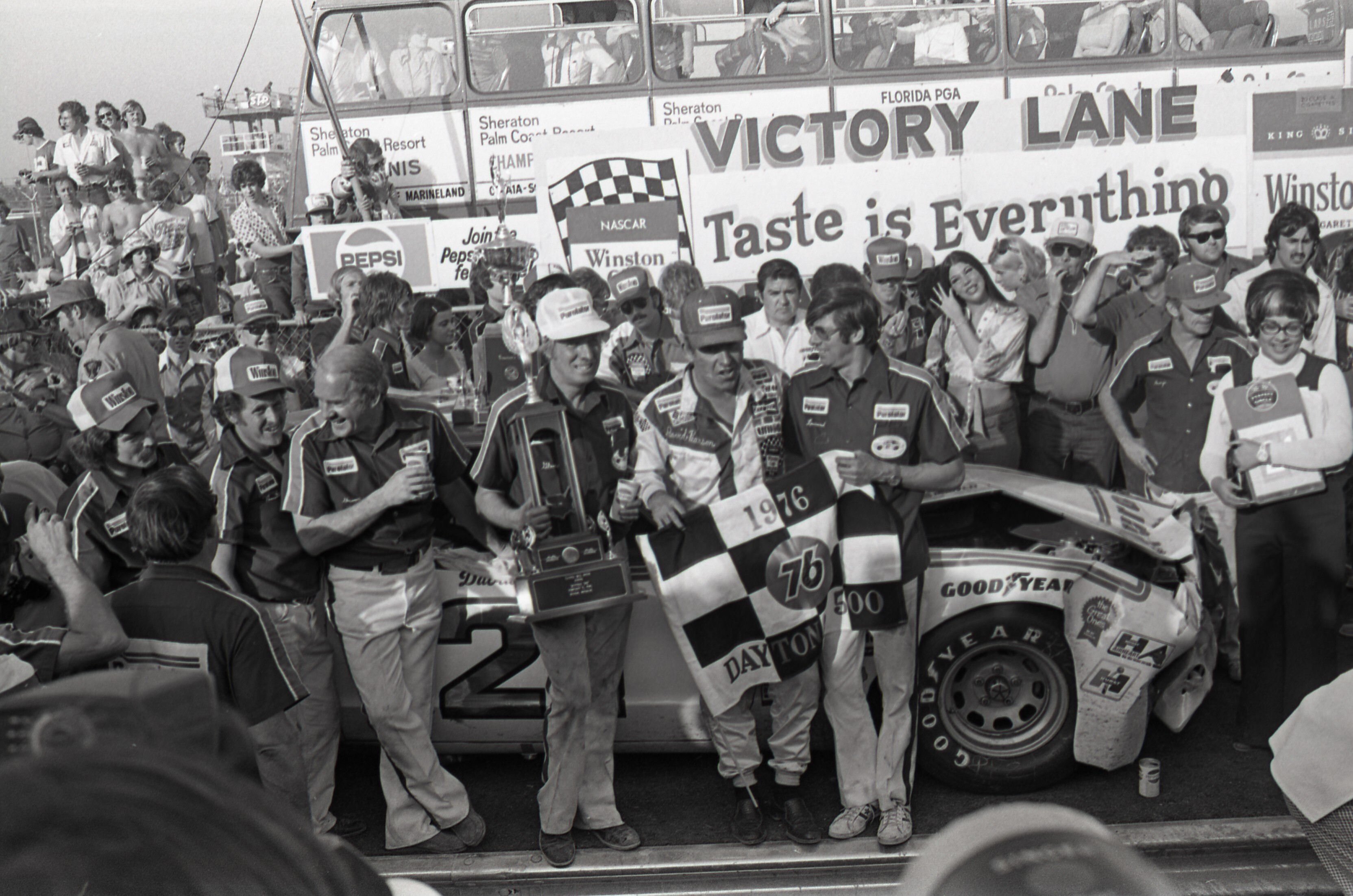
Flanked by team owner Glenn Wood (left) and crew chief Leonard Wood (right) David Pearson raised the 1976 Daytona 500 flag in Victory Lane. NASCAR Hall of Fame Permanent Collection, gift of William Joyner
One combatant was “The King,” Richard Petty, NASCAR’s all-time leader in Cup Series wins with 200 and a member of the NASCAR Hall of Fame’s inaugural Class of 2010. Petty fought through illness, as he was coming of a 10-day stint in a Greensboro, North Carolina hospital, where he was being treated for a peptic ulcer. “The King” arrived in Daytona just prior to qualifying. On the mend or not, he was ready to race.
The other contender was Class of 2011 inductee David Pearson, known as “The Silver Fox,” winner of 105 races, which ranked behind only Petty in the all-time NASCAR victory list. Without question, Pearson wanted to win badly. He had won the summer Daytona race, the Firecracker 400, four times already, but never the Daytona 500, which Petty had won five times prior to 1976.
Their teams were as storied as the drivers.
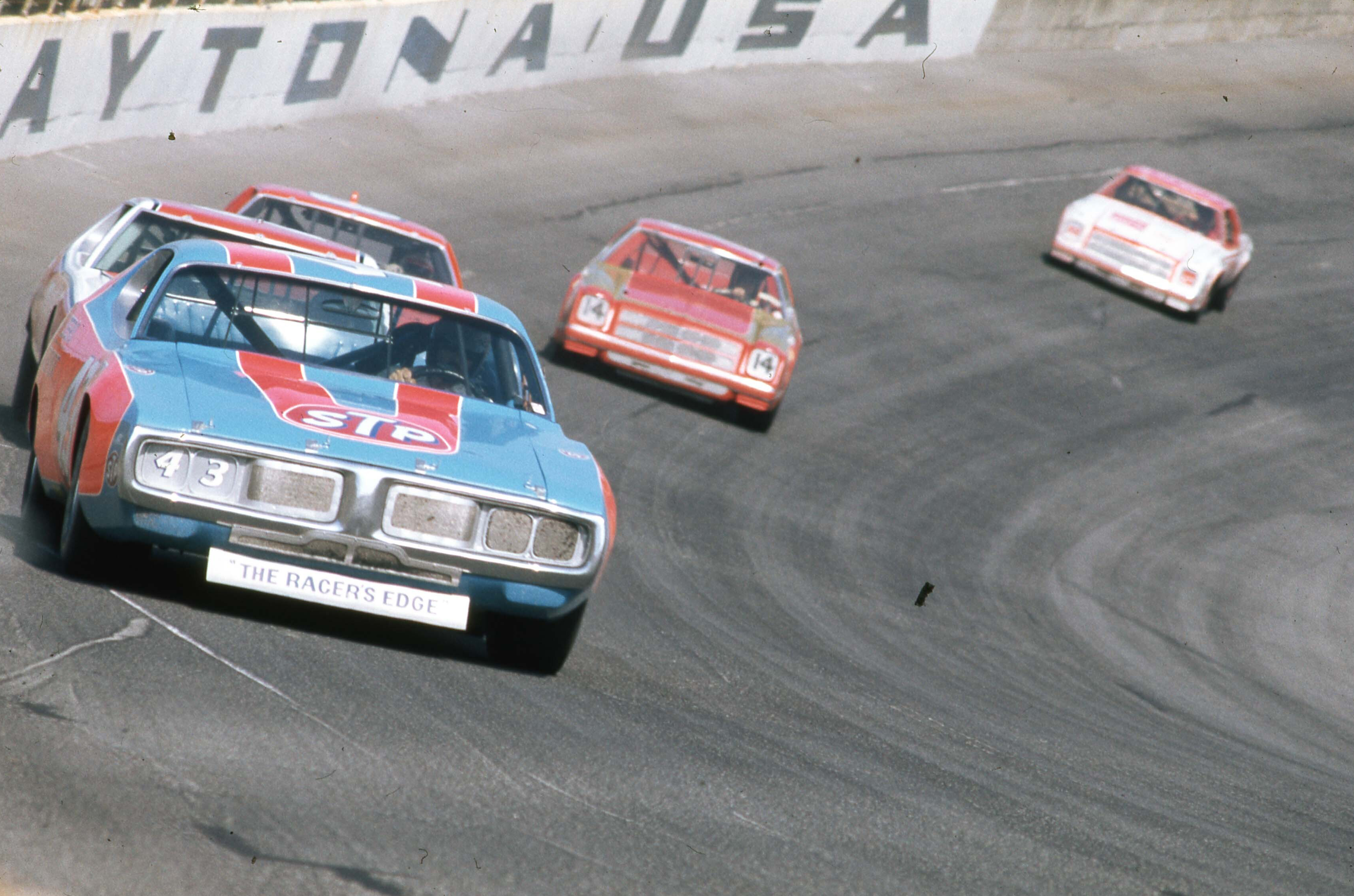
Richard Petty (No. 43) came into the Daytona 500 as the favorite to win. NASCAR Hall of Fame Permanent Collection, gift of R.J. Reynolds Tobacco Company
Petty raced for the operation started by his father Lee Petty (Class of 2011) in Level Cross, North Carolina in 1949. A year later in Stuart, Virginia Glenn Wood (Class of 2012) founded Wood Brothers Racing, the team Pearson drove for.
Petty piloted the No. 43 Petty Blue and Day-Glo Red Dodge, Pearson the red-over-white No. 21 Mercury. They were two of the most recognizable and iconic cars of their or any other generation, of NASCAR competitors.
Petty and Pearson were the biggest names of their era and before they retired, they would go on to win a combined 10 Cup Series championships and 305 races. Simply put, they were the best of the best. The drivers knew it, the teams knew it and the fans all knew it, too. In a sport filled with talented, brave and hard-charging drivers, these two stood above all others.
Sixty-three times the duo of Petty and Pearson finished 1-2 in Cup races, with Pearson winning 33 times to Petty’s 30. But none of the other 62 finishes held a candle to the 1976 Daytona 500.
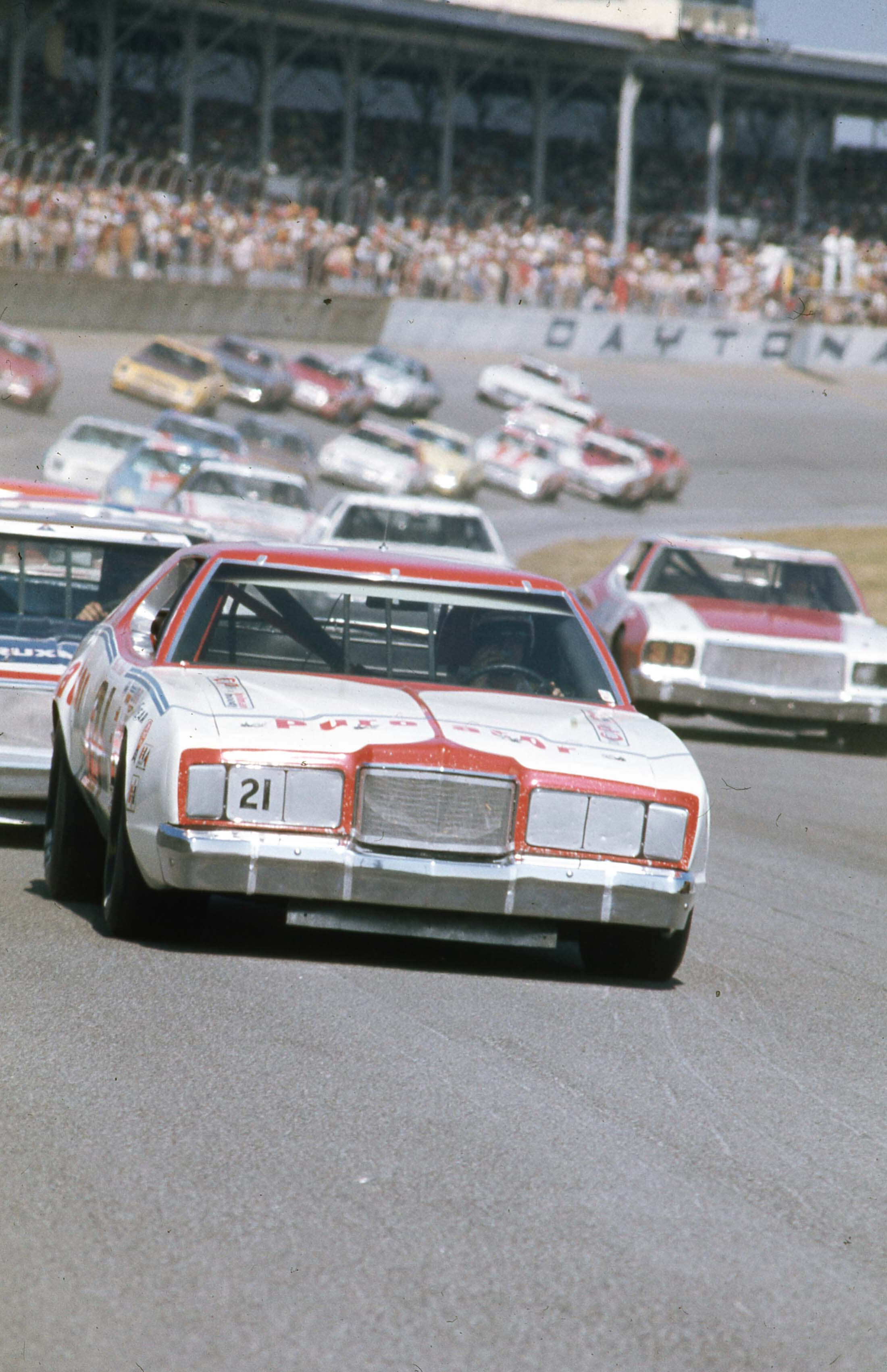
David Pearson (No. 21) came to Daytona in search of his first victory in the Great American Race. NASCAR Hall of Fame Permanent Collection, gift of R.J. Reynolds Tobacco Company
The NASCAR world was very different in February 1976.
There was no live, flag-to-flag television coverage at that time, although ABC would switch from the Winter Olympics to air portions of the race on its popular “Wide World of Sports” show.
Attrition was an issue those days, as only 21 of the 42 cars in the Daytona 500 finished the race.
Teams didn’t use spotters then and not all teams even had radios. Eddie Wood was the only crew member of the Wood Brothers team who had a radio and could talk with Pearson.

Teams didn’t use spotters then and not all teams even had radios.
— Tom Jensen
After the three fastest qualifiers all had their times disallowed because of various rules violations, journeyman Ramo Stott was awarded the only pole of his career, qualifying at 183.456 mph in car owner Norris Reed’s Chevrolet. It was the only race either man would enter that season. On the outside pole was another unknown, Terry Ryan, who like Stott was an Iowa native.
Stott never led a lap, as he was passed by Buddy Baker (Class of 2020) on the opening lap and eventually succumbed to engine failure. Mechanical woes also knocked out Baker, Bobby Allison (Class of 2011) and Class of 2012 inductees Darrell Waltrip and Cale Yarborough, among many others.
The fastest car in the race was Hoss Ellington’s Chevrolet, which was driven by open-wheel star A.J. Foyt, who led 66 of the first 143 laps before his engine let go, making him another casualty of mechanical failure.
In the final 50 laps of the race it became apparent that Petty and Pearson were the men to beat. All told, Petty would lead 40 laps of the 200-lap event, with Pearson out front for 37 more. As the race neared its conclusion, Pearson and Petty already had lapped the field. Now, it was just two men battling for one trophy.
The white flag signaling one lap to go fell with Petty leading Pearson.
And then all hell broke loose.
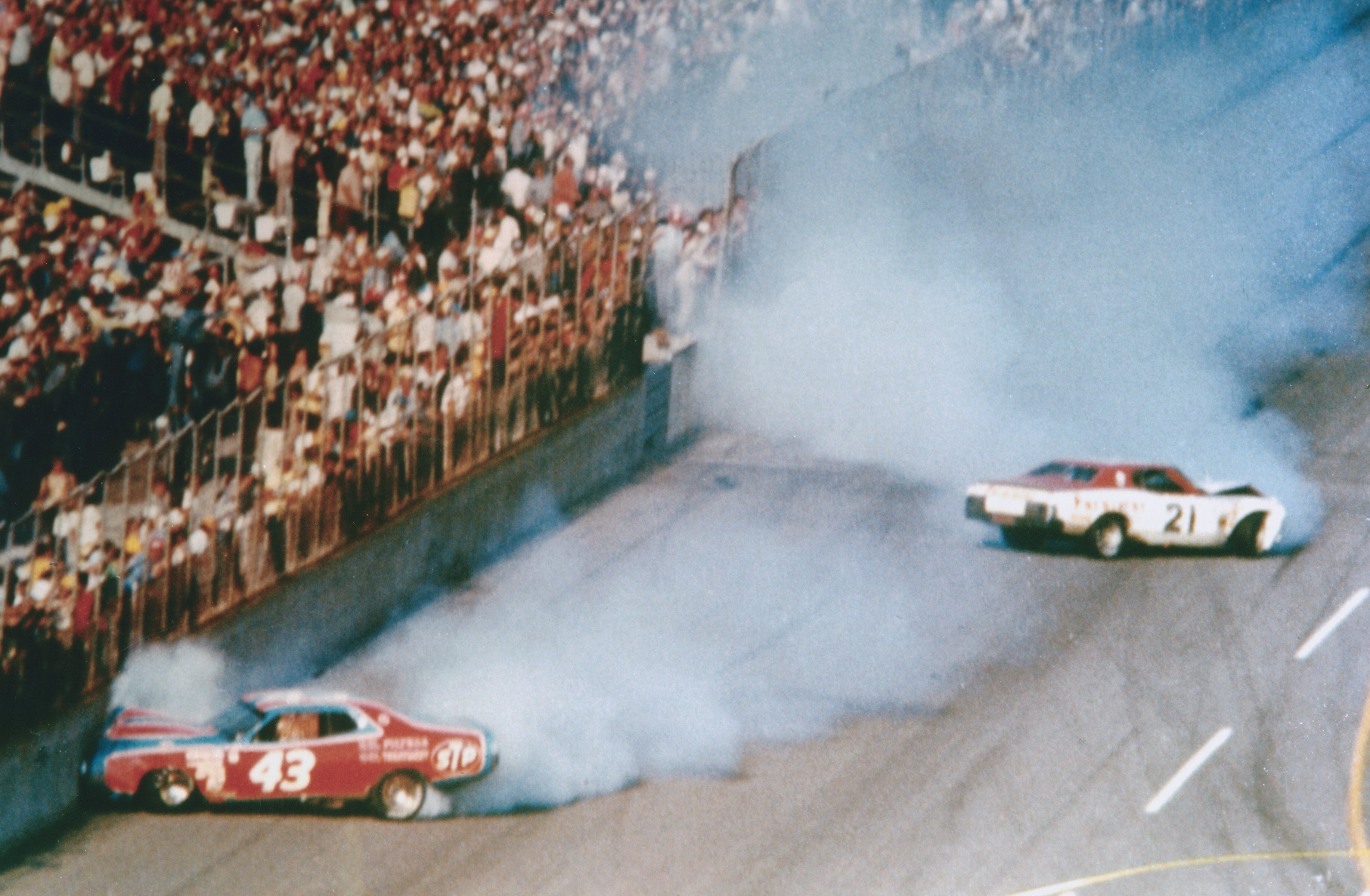
The last-lap crash between Richard Petty (No. 43) and David Pearson (No. 21) stunned the sellout crowd at Daytona International Speedway. Photo courtesy NASCAR Archives & Research Center via Getty Images
As they headed down the backstretch, Pearson dove under Petty to take the lead going into Turn 3.
Petty then tried to return the favor, ducking low into Turn 4.
At the exit of Turn 4, the two made contact, with Pearson hitting the outside wall first and spinning into the infield. A split second later, Petty did the same.
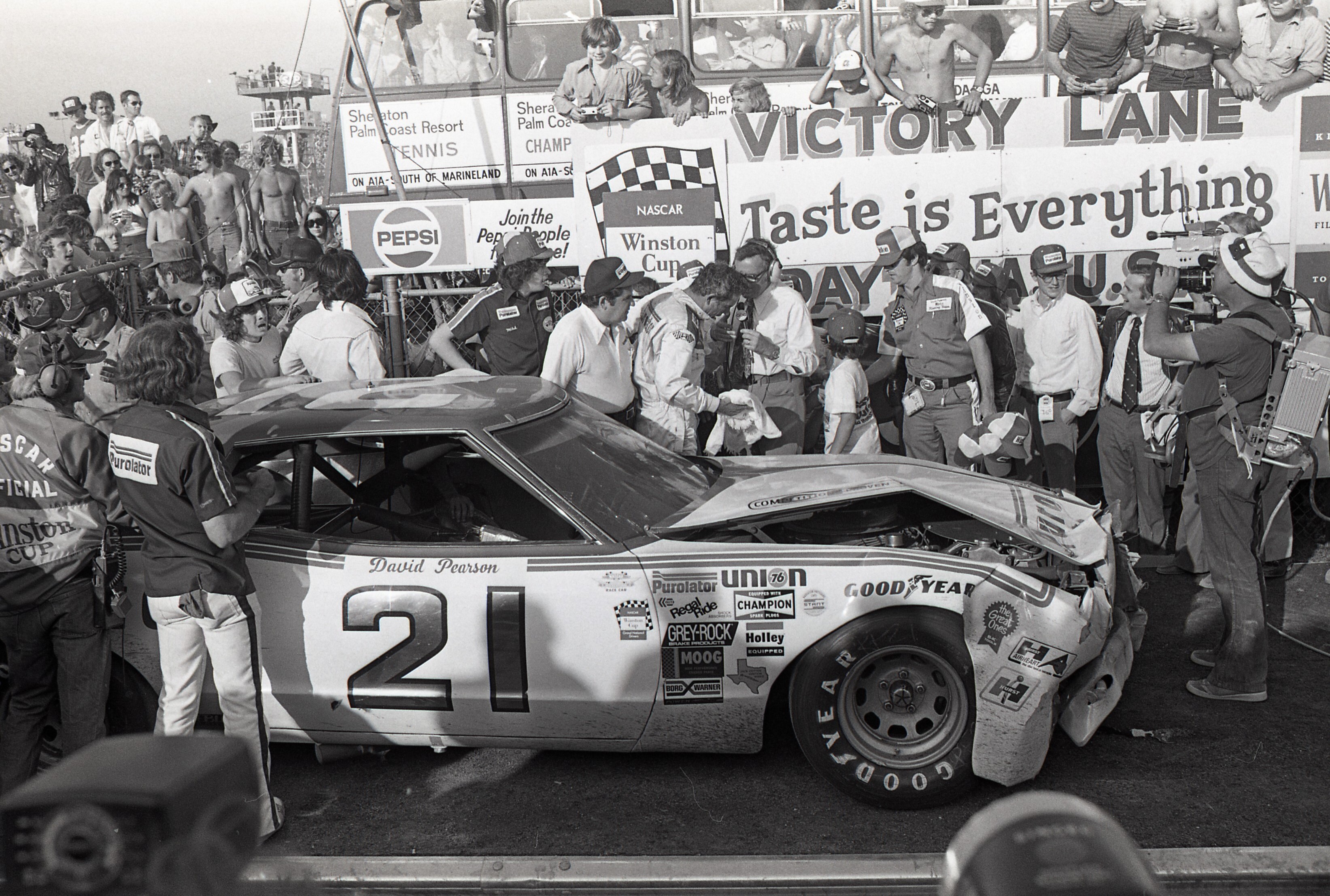
The heavy damage to the Wood Brothers No. 21 Mercury was clearly visible in Victory Lane at Dayona. NASCAR Hall of Fame Permanent Collection, gift of William Joyner
After the crash, Petty’s Dodge stalled, while Pearson pushed in the clutch on his Mercury and took the car out of gear, keeping the motor running. Despite heavy damage to his car, Pearson was able to put the car back into gear and limp across the finish line as Petty sat helplessly in his wounded car just 100 yards or so from the start-finish line.
Petty’s crew rushed to the infield to push the car to no avail. The race ended as soon as Pearson took the checkered flag and besides, it was – and still is – illegal to push a car across the start-finish line.
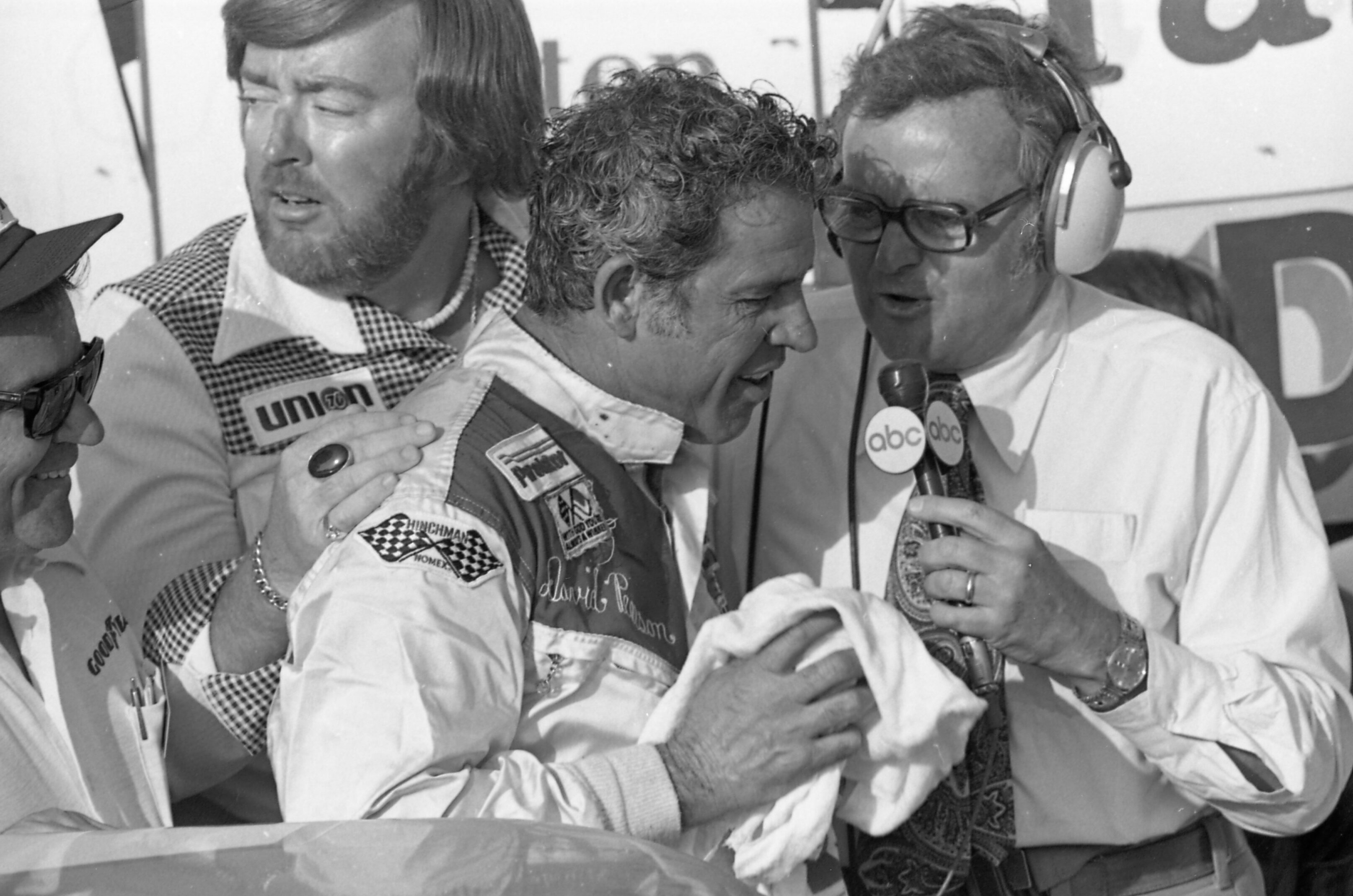
After his stunning triumph at Daytona, David Pearson was interviewed in Victory Lane by ABC Television’s Chris Economaki. NASCAR Hall of Fame Permanent Collection, gift of William Joyner
While Petty may be “The King,” on this day, it was Pearson who took the crown, winning the largest purse of his career at $46,800, and giving the sell-out Daytona crowd a memory they would never forget. And the race would be immortalized not only as one of the most thrilling Daytona 500s of all time, but one of the best NASCAR races ever.
Relive the moment on YouTube and plan a visit to the NASCAR Hall of Fame.